Showing posts with label real homeschool. Show all posts

Saturday, May 20, 2023

Biology Lab Intensives : A Homeschooling Take

Biology lab of BRKM
What homeschoolers think of when they hear 'high school science'

Note: Photos below include a dissection specimen which may be distressing. 

Homeschoolers often dread the middle and high school years because the subjects seem too difficult, and they lack funds or equipment. Ironically, Covid partially allayed these fears because classes moved on-line so now an entire year of virtual labs can be found.  However, hands-on experience is still a more effective means of learning for several students, so we hope the following can encourage others to be creative in seeking options.  

Goal: In our case, we had a group of middle school students who would be taking Biology next year and had different levels of exposure to its topics. We designed a four week series of lab intensives, focusing on microscope use and dissection. The goal was to become comfortable with the tools used. 

Where: We opted to meet at a member's house, though a church or community facility rental would also have worked. Note that dissection specimens are well preserved, so although there is some smell while working on it, it does not smell when everything is bagged up at the end of class. 

Who: The LORD provided a alumni homeschool father who is also a doctor and who volunteered to teach our class. Other options would be asking independent teachers, e.g. HEART Academy (not affiliated), recent homeschool grads who are home from college, or the community at large, e.g. BioCurious.  The class was open to middle and high schoolers, as well as parents who wanted to refresh their skills before teaching their younger students.

Equipment

  • Microscopes: We rented microscopes from HEART Academy (~$15/scope/month), some families borrowed from their charter lending library though they would plan to request months ahead. Families can also purchase them - Home Science Tools and AmScopes both have a section dedicated to high school microscopes.
  • Slides, staining reagents: We rented prepared slides from HEART Academy (~$2/month), and purchased Methylene Blue and Eosine Y from Home Science Tools  (~$5/bottle) as well as a box of glass slides (flat and concave) and covers
  • Pocket Microscope (optional): This was recommended by the teacher as a field microscope for students who want to keep exploring. Also suitable for younger children.
  • 7" preserved rat: Since some students might take anatomy in high school, we wanted to cover mammalian systems. To keep the scope manageable, we went with a rat since a mouse might be too small to see the organs or, and a pig too large. 
  • Dissection tools: We rented the kits from HEART Academy (included in price above), but the most important tools were the sharp dissecting scissors and forceps (~$5 for both at Home Science Tools). For gloves, we used disposable gloves from Costco.
What:
  • Week 1: We learned the parts of a microscope and examined different slides, drawing them. Students were initially unused to squinting (most microscopes were monocular), and not losing focus when moving between their paper and eyepiece.


  • Week 2: We collected pondwater and put it on a concave slide to observe. Students were amazed at the diversity of life when magnified. They also scraped their inner cheek cells and stained them using different dyes to observe (methylene blue highlighted the nucleus, eosine highlighted the cytoplasm).
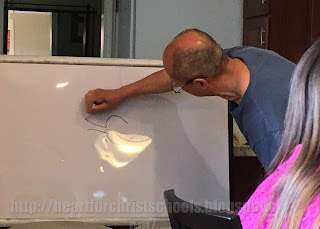
  • Week 3: Our teacher first emphasized that dissection isn't for fun, but a tool to understand God's creation better. We defined terms - remembering that left, right are from the ANIMAL'S point of view (this worksheet is helpful). He provided various models using balloons and pumps on how our circulatory and respiratory systems work. Students then made their first incisions (with much squealing) and realized it is hard work to cut past the fur, epidermal, muscle layer and get to the organs. It is also very easy to cut too far.  At the end of the session, we bagged up our specimens for the next lesson (they don't need to be refrigerated).


  • Week 4: We covered the digestive system, and pulled out the corresponding organs. In the rat, the distinction between small and large intestine isn't as clear as in human's, nevertheless we had several opportunities to point out how finely God had made the systems, e.g. the loops and vilia to help maximize surface area and uptake absorption of nutrients. Our instructor had also bought some cow hearts so he could demonstrate the chambers, and poured water to demonstrate the valves preventing the liquid from flowing backward. 


Thus we wrapped up our series of intensives. We praise God for providing a knowledgeable teacher - he would have been able and happy to teach to more detail, but we felt the material was enough for the students to feel comfortable when doing their classes next year, and eager to learn more.

We hope this post encourages the homeschooling community at large - equipment and materials cost came to about $45 per family, and students had an entire specimen to themselves (or shared with a sibling). If the LORD has provided a school or co-op near you with facilities, praise God! But if your options seem out of budget, pray and wait on Him - it is amazing what He brings about. 

Wednesday, March 18, 2020

Real Homeschool: A Shelter-In-Place Homeschool Day

Jonagold


Editor's note: 'Real Homeschool' is a series of blog posts by different families in our homeschool community. They reflect an honest, 'in-the-trenches' view of homeschool life - today's post talks about chores, homeschooling with toddlers, quiet time and more! For those new to homeschooling, real life seems to get in the way of learning but we learn the two can co-exist and even thrive as the Lord helps us to carry on with faith, trust and a good dose of humor. To be encouraged by other posts in the series, click here.

This letter is from homeschooling mom 'H' who has four children aged 13 months to 11 years, and lives in Half Moon Bay.
-------------------------------------------------------------------------------

I would just like to preface this with saying that we usually have very full and structured days. Most often my children have live online classes 4 days per week and then on top of that have live online art/music/nature study class twice a month. Along with weekly piano and ceramics classes, church youth group and soccer practice and 4-h meetings. To say the least we are a busy bunch. We are usually leaving the house 4 days out of the week for some activity and have online classes to attend. So this shelter in place has been rather a nice change for us. It has let us sleep in and continue with our online classes but not have to rush about town all the time to make it to lessons and such. So this is how things are rolling nowadays.

My kids are ages 11, 10, 4 and 13 months. We have homeschooled since the beginning and I have found over the years that our daily schedule changes with each new homeschool season. Take it for what it is, and I hope it helps to know that as long as you are loving your family and staying calm, the rest will come. Pray and have faith, be WITH your family, not just around them. Enjoy the short time we have with our children and take time to just breathe.


Bible on Table (Unsplash)My day usually starts with me waking at 6-7am, then boiling some water around 8am to make my pour over coffee. Then I turn on my Bible app and have the day's reading read aloud to me. I'm reading through the bible this year and having a plan to follow makes this something that actually gets done daily. I'll start a load of laundry, turn on the diffusers and open up all my curtains and a few windows. When that is all done, my coffee is ready to be made. I'll pour myself a cup and usually check my emails and my YouTube feed while I eat breakfast. It's important for me to have this morning time to myself. Alone and calm. I really do better throughout the day when I can start my day in the calm.

World Map 1689I usually will wake my kids up between 8-9am. They eat breakfast and feed their animals and play until about 10 or 11am. We all start school around the kitchen table. I read our family devotional and a chapter or two out of our read aloud while the kids do their paint by sticker books.
 Then we move straight into history, listen to the chapter and do our mapping activities. Sometimes we will look up something online or watch a video, but usually just mapping and then move on.  Grammar, spelling and vocab are usually next in line. Memory work and anything they need me for is done first together.


Piano practice hands Then we will have a break - the kids go outside for an hour or two, do chores and play. We come back in and eat lunch, then I work with my younger preschooler while my baby (hopefully) naps. At this time I'm pretty done for the day emotionally, meaning I just want quiet time and to read or have the kids be calm. The older kids will finish all their independent work, math, typing, reading, science or anything else they need to finish up. They practice piano and we will go for a walk or they just play for the rest of the day.


I try to start dinner and have the kids play outside or in their rooms. We eat dinner as a family and then usually clean up and then watch something on Youtube or Netflix together. Then the kids go to their rooms to do reading and relax and lights out usually around 10ish.

Here are some resources I’ve found helpful for learning:
Pepys copy of Willughby's Ornithology

YouTube channels

Websites that are free or just good content

Potentilla indica - Institute for Nature Study, Tokyo
There are soo many wonderful blogs and free websites that it would be too much to list!

Sunday, March 15, 2020

Real Homeschool: A Letter from a Homeschooling Mom In Light of COVID-19

Jonagold


Editor's note: 'Real Homeschool' is a series of blog posts by different families in our homeschool community. They reflect an honest, 'in-the-trenches' view of homeschool life for families with different demographics and situations. Because homeschooling is as much about everyday life as it is about academics, we hope they reassure and encourage you. We can indeed give thanks in all circumstances, because God is good.  To read other posts in the series, click here.

This letter is from homeschooling mom 'K' who has two elementary- aged children and lives in San Mateo.
-------------------------------------------------------------------------------

March 14, 2020
 

Hi mamas!
 

I hope everyone is staying well emotionally as well as physically while we grapple with the changes caused by this unprecedented coronavirus landscape. I was asked to share some insights as a homeschool family to those of you who have suddenly found yourselves living the homeschool lifestyle. It is my hope that this message can be of some help and encouragement to you!
 

Just so you know, there are different ways to homeschool, and I don’t represent them all, but I am happy to share from our perspective as private home educators (which means we are like a small private school) with elementary-age kids. I am far from a perfect homeschool teacher, but I hope to encourage you with ways to make the most of this time.
 

I want to first acknowledge the variety of emotions I imagine are represented among you right now as well as perhaps some mixed emotions you might have as you look ahead to schooling at home. Perhaps for some of you, the prospect of educating your kids at home has you feeling curious or even excited. Or perhaps you are at a loss and feel daunted about how to go about it as you await guidance from the schools. Some of you may even honestly feel some dread or frustration at the idea of this prolonged period at home. And others are having to navigate the world of being a stay-at-home parent when you are normally working. I acknowledge all those possibilities, the challenges, and the sacrifices you need to make. It will be an adjustment for sure, but I want to offer some encouragement, tips, and resources to help you survive and hopefully thrive during this time. “My times are in Your hand.” – Psalm 31:15
 

Hands-free hugs and grace and peace,
K


Bumblebee on Lavender Blossom

My Humble Pep Talk to You

1. First, I really believe this time can be a special gift to you and your family. Your kids are only this
age once, and these weeks won’t last forever. This can be a really sweet time of family bonding.
 

2. You can do it – it doesn’t take someone special or specially trained, just an open mind and willing
heart. People always tell me they aren’t cut out for it, but as a parent, you
already do lots of things
that are an aspect of educating your children, just without the title of homeschooling. You teach
manners, read to your kids, help with homework, play with your kids, help them navigate
interpersonal challenges, answer the big and little questions of life, etc.
 

3. Embrace the freedom and flexibility – It’s not the same as the normal freedom and flexibility you
get to experience when the kids are in school, but you have a lot of say in what the school day will
look like (unless your school has very specific instructions). You can choose what time you start and
end. You can snuggle up to read on the couch, do schoolwork in the backyard, or sit at the kitchen

table. You can schedule most schoolwork Monday-Thursday so that Friday is a light day to have
more family time or safe excursions. You can schedule breaks when you want.
 

4. Go easy on yourself and your kids – homeschool parents don’t have perfect patience as much as
people imagine they might; it’s just constantly fine-tuned by the on-the-job training, and you’ll be
fine too. Anticipate challenges and ask for God’s help to apologize and forgive as the need arises.


Ice cream in cup with sprinkles and spoon

Tips & Tricks that Work for Us

1. Create a schedule/plan for the day – no need to stick to it strictly but let it shape your day and
free your mind to focus on other things; let your kids be a part of this if you like. If you make the
most of the morning, more of the afternoon is free for other activities and for chores (for you
and your kids). I like to have my kids do a brief
daily journal (you can pick any prompt you want
– what they are looking forward to or thankful for, etc.). These days I ask them to also make a
plan for their day so they can remind themselves to practice piano, read, etc.
 

2. If you have more than one child, some subjects can be learned together to save time (science,
PE, art)
 

3. Allow for independent work time, which lends itself well to subjects such as math & language
arts, so that you can get some housework, meal prep, or other things done. This kind of multitasking will help you manage your time. You won’t need separate class time and “homework”
time since that’s all wrapped up together. Check in with your kids and help as needed.
 

4. Make room for unstructured independent free time when work is done. Offer some options
for how to fill this time (crafts, reading, games, outside play, writing letters). We happen to be
more low-tech and keep the kids off TV and devices. We find it lends itself to more creativity
and learning how to manage boredom. Feel free to be creative.
 

5. Make the most of this time to build special memories and make it fun. You’ll have extra time
outside of academics. You can make special snacks, have tea time on your favorite china, cook
and bake together, work in the garden, do special science and art/crafts projects, do a home
project, organize the house, and play games together. One of our favorite bonding activities is
read-aloud time, which I think works well even for older kids. It’s a great shared experience,
like going on an outing together. A great chapter book draws everyone in, and we often talk
about or refer to these stories long after we’ve read them. And great books infuse our hearts
with inspiring ideas as well.
 

6. Ask for help from your kids with meal planning and simple chores to make it a team effort.
 

7. Take breaks and get outside for fresh air, even just walking around the block.

8. Create a simple system to keep track of workbooks/papers – I’ve found that an inbox and
outbox work great. Inbox for the work your kids turn in to you, and an outbox for what you
give back. (My kids’ advice is to make sure to check it and return it in a timely manner!)
 

9. Create a conducive atmosphere and watch your distractions – you can play music in the
background and have a clear space to work. Although distractions abound (piles of laundry and
dishes, devices galore, emails, phone calls, etc.), you can try to set parameters around when
you will take care of these. It’s easier said than done, but awareness will help!
 

10. Rewards and incentives – someone asked me about how we do this. I’m not great at making
room for rewards (hey kids, isn’t education a reward in itself?!), but one idea is to have a reward
jar and fill it with marbles or the like as kids do well and complete their work. When the jar is
filled, have an ice cream celebration or something like it that they would enjoy.


Books in the Handa Library

RESOURCES I CAN RECOMMEND (FREE)

There are millions of resources out there for homeschooling. Here are just a few that are easy and trusted.(We try to mostly use actual books, but these are really great resources that are easy to access and free.) 

1. Faith – devotionals
Keys for Kids Devotional
(online, app, or paper version)
Teen Devotional (online or paper version)

2. Faith – music
A specially curated Spotify playlist for hope and peace in these times (from a friend/worship
pastor)


3. Math
Khan Academy
(tailored info regarding how to use it during school closures)

4. Science:
Mystery Science
(my girls love this! This link is tailored to current school closures)

5. Language Arts
Hammermill: Printable resources for elementary, middle, and high school

6. PE
Go Noodle

7. Multi-subject
Easy Peasy All-in-One-Homeschool

FUN BOOKS I CAN RECOMMEND

1. Math  

If you want to use some traditional books, I love Life of Fred as an easy math supplement.
It’s a quirky chapter book format that focuses on concepts and how to think. You can figure out
which book to start with here


2. Fun science experiment books:
Smithsonian Maker Lab

Edible Science
Cool Chemistry Activities for Girls (there’s also a physics and engineering book in the series)


Louvre Museum Wikimedia Commons

OTHER RESOURCES (NOT VETTED BUT SHARED BY OTHER HOMESCHOOLERS – ALL FREE):

1. Virtual museum tours

2. Free online educational resources:

3. More free online educational resources

Wednesday, July 25, 2018

Real Homeschool : Teaching Young Ones through Everyday Life

Jonagold

This is the first post in a series called "Real Homeschool" where  members from our group share about their homeschool days. We hope this encourages you in your journey - not every moment needs to be meme-worthy or profound, but the learning and living is real.  To read other posts in the series, click here.

Today's post comes from a member with 3 young ones: G. (7 years), O. (5 years) and D. (3 years).

I love using everyday activities to teach the kids.  This morning we were making bacon in the microwave and it takes a minute per slice.  I was also making one slice for each kid so I decided to ask, hey does anyone know what ratio is?  Of course they don't, we have not covered this topic formally yet.  But they love new words so they were curious and it had to do with their bacon so they were interested.  So I explained that 1 piece goes in for 1 minute and that is a 1:1 ratio.  Also we are having 1 piece per kid so that is 1:1.  What is I put the bacon in for 2 minutes what would be the ratio there?  Also given that the cooking suggestion is only 1 minute what would happen if I doubled it?  I just try to think of fun questions that will get them thinking and make them laugh.  They all thought the burnt bacon possibility was hilarious (at ages 3,5, and 7 it doesn't take much).  I love when they can learn this way because it is so natural and stress-free. 

 My kids just aren't the kind of kids who enjoy worksheets and although I sometimes require them to do the sit down type of work, I find that they learn more when they are enjoying and naturally curious which for us tends to happen when connecting learning to living.

Typical Day

We try to learn by living meaning we just go about our days and I interject lessons into things.  We do chores (unload dishwasher, sort laundry, replace toilet paper role, put dirty clothes in washer, take out trash and recycling) and play and just turn stuff into lessons naturally.  Like, when handing out apple slices to 3 kids and we have 12, how many does everyone get?  

We play outside a lot just digging in the dirt and climbing on the climber and riding bikes.  We write when we need to make a shopping list or send a thank you note.  O. and D. seemed to just write naturally and copy anything they saw in books, but G. needed to really practice forming the letters so we made them out of playdoh.  

We go out a lot of places like Cantor Arts Center, Tech Museum, Palo Alto Jr Zoo, SF Zoo, Coyote Point Beach, Curiodyssey.  G. and O. have taken art class at Marvegos in San Mateo, O. does gymnastics at Bayshore Elite in Redwood City.  We have also done swim lessons at Sequoia YMCA and art classes at Laurel Street Arts.  We use Ocean Grove Charter School and do a daily computer lesson called Iready (about fifteen minutes, half math, half language arts) usually in the evening.  

List of Subjects/Areas

Math: Singapore Math, G. and O. do an online private math tutoring sessions once a week with Jen Caddell and we keep up with homework during the week. (https://www.adventuresforyoungexplorers.com/meet-your-teachers.html - her first lesson is free, she is also a Christian homeschool mom and she is Ocean Grove approved)

Reading: We started with www.starfall.com and moved on to Hooked on Phonics Ipad app.  We also use Leap Frog videos like talking words factory and rock n learn dvd series (https://www.amazon.com/Sight-Words-Level-Rock-Learn/dp/B0056ZU41E) . We visit library several times a week

Science: We play with science materials like baking soda and vinegar, molecule building set, snap circuits, and we build with legos and blocks a lot.  

History/Geography: We build map puzzles (Geopuzzles) and draw our own maps.  We play with flash cards and placemats of the US presidents.   

Bible: During the school year we do Bible Study Fellowship (https://www.bsfinternational.org/) and the Peninsula Covenant Church class in Redwood City meets Wed AM and has homeschool classes.  We watch videos (I try to limit screen to an hour a day) on Right Now media or https://crossroadskidsclub.net/video/